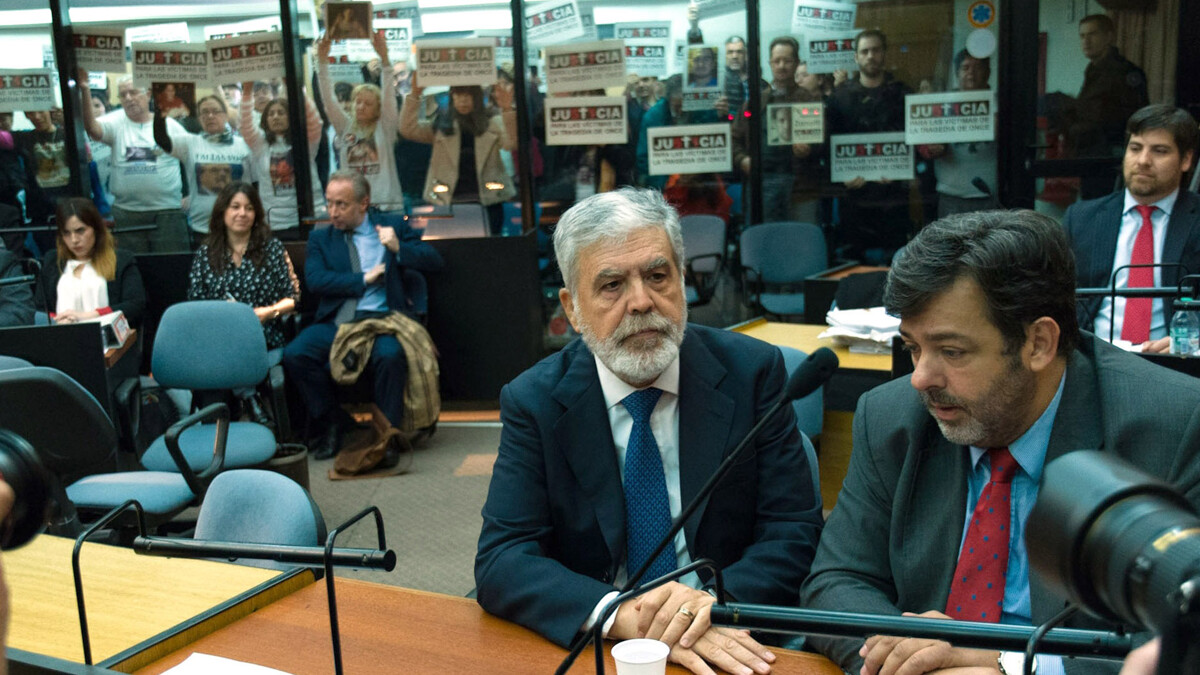
Buenos Aires, November 11, 2025 – Total News Agency-TNA – Julio De Vido, former Minister of Planning under Kirchnerism, received a major judicial blow this Tuesday. The Supreme Court has put an end to the extraordinary appeal, making the sentence final. This judicial advance also represents a symbolic setback for the era led by Cristina Fernández de Kirchner, during which state structures operated with opacity, clientelism, and corruption deployed against popular sectors. De Vido, who is attributed to have been in charge of state spending and supervision while negligent concessionaries operated—such as Trenes de Buenos Aires (TBA) on the Sarmiento line—now carries a sentence that seemed improbable due to his political influence and the delay in trying high-ranking officials. Although he was not convicted for the crime of negligent manslaughter—which would have implied attributing to him the deaths and injuries of the victims—the sentence does hold him responsible for his omission in the control of public funds that allowed the deterioration of the railway system. The fact that it has taken over a decade for this sentence to become final only reinforces the criticism of the slowness of the judicial system in the face of hegemonic political power. The ruling also puts pressure on the court that must now decide if De Vido will have to serve his sentence in a common prison or if he will obtain house arrest for reasons of age. The Supreme Court of Justice of the Nation rejected as “inadmissible” the appeals filed by both the former official's defense and the Public Prosecutor's Office, leaving the sentence of four years in prison and perpetual disqualification imposed on the defendant for the crime of fraudulent administration to the detriment of the public administration, in the framework of the Once Tragedy, which occurred on February 22, 2012, and left a balance of 51 dead. The detainee, who had been under house arrest in Zárate, had parliamentary immunity to avoid immediate imprisonment. For Argentine society, the fulfillment of this penalty represents an opportunity to advance in accountability, so long overdue. But for this to translate into real changes, public policies will be required that combat not only corruption but also the culture of impunity that sustains it. The ruling places the competent oral court in a position to execute the sentence, which opens the possibility of De Vido entering effective prison. The decision confirms a pattern of institutional irresponsibility and systematic corruption that characterized Kirchnerism in railway and public services matters. While Kirchnerism continues to resonate among segments of the electorate, this type of resolution contributes to wear down its moral image and underscores the need for profound reforms to prevent tragedies of this magnitude from repeating. But it also evidences that the path to justice is long and fraught with obstacles when it comes to holding high-ranking figures of state power accountable. In the trial initiated in 2018, the Federal Oral Court No. 4 found him guilty of fraudulent administration and sentenced him to 5 years and 8 months in prison, a later reduced penalty. The mere fact that Kirchnerism still has parliamentary representation speaks volumes about the damage it did to society by fostering fanaticism. Finally, it remains to be seen how the sentence will be executed and what signals the State will send regarding the commitment to comprehensive reparation for the victims. In a looted country and as a consequence of this, poverty, insecurity, and deficient infrastructure continue to hit the population hard, that the ruling against De Vido becomes final can be a step towards a greater demand on power. The Once Tragedy is perhaps the most visible case of how that combination of negligence, lack of maintenance, political impunity, and subordination of public services provoked a disaster in which dozens of Argentines died.